
Compare Blasting Abrasives
Crushed Glass vs. Silica Sand Blasting Media
Choosing blasting media calls for more than comparing purchase prices. Learn how Zafa recycled crushed glass and crystalline silica sand differ in material source, dust hazards, surface preparation and total job cost.
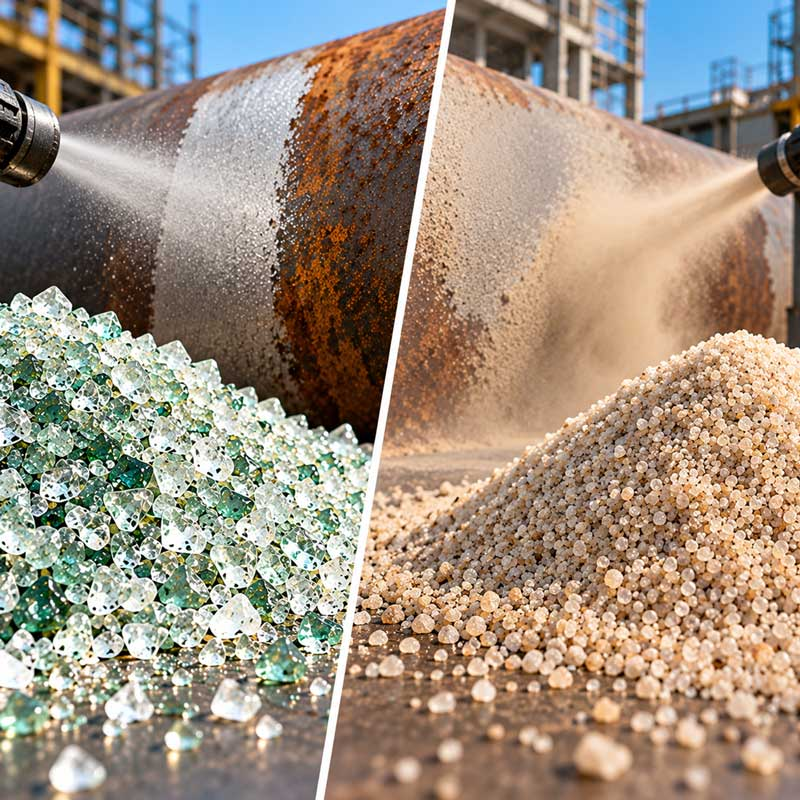
How the Two Abrasives Differ
Zafa crushed glass comes from recovered industrial sheet glass, including solar panel cover glass and non-leaded CRT panel glass, processed in Lawrenceville, Georgia—not bottle cullet.
Silica sand is mineral sand that can contain crystalline silica. Abrasive blasting with silica sand can generate respirable crystalline silica dust. Glass has an amorphous structure, but a grade-specific laboratory XRD report is required to substantiate Zafa’s product test results.
Crushed Glass vs. Silica Sand: Comparison Table
| Comparison factor | Zafa crushed glass | Silica sand |
|---|---|---|
| Source | Recovered solar panel cover glass and non-leaded CRT panel glass | Naturally occurring mineral sand |
| Silica structure | Glass is primarily amorphous; Zafa grade-specific XRD results: [lab report pending] | Contains crystalline silica; actual percentage varies with the sand |
| Dust exposure | Dust can still be produced during dry blasting | Abrasive blasting can release respirable crystalline silica |
| Coating/substrate hazards | Hazards from paint, concrete and other surfaces still require assessment | Hazards from coatings and surfaces also require assessment |
| Quality documentation | Request current TDS, SDS and lot-test results | Request supplier SDS and particle-size data |
| Product sourcing | Recycled industrial glass recovered in Georgia | Often virgin-mined material; verify supplier |
| Performance | Depends on mesh, equipment, surface and target profile | Depends on grain size, equipment, surface and target profile |
| Cost | Compare delivered cost and tested consumption, not only $/lb | Compare delivered cost and tested consumption, not only $/lb |
Crystalline Silica & Worker Exposure
OSHA identifies abrasive blasting with silica sand as a source of exposure to respirable crystalline silica. Replacing silica sand with a media not containing free crystalline silica can remove the abrasive itself as that source, but it does not eliminate the need for exposure assessment or other safety controls.
Blasting concrete, coatings or lead-painted surfaces can release hazardous dust regardless of the abrasive selected. Evaluate the complete process, use appropriate engineering controls, respiratory protection and containment, and follow applicable workplace requirements.
OSHA crystalline silica guidance · OSHA abrasive blasting hazards fact sheet
Material Quality and Documentation
Zafa’s sourcing process separates solar cover glass and non-leaded CRT panel glass from other fractions. Leaded CRT funnel glass is excluded. Ask for current grade-specific XRD testing, RCRA metals lot summaries and technical documentation before writing a material specification.
To verify before publication: XRD laboratory name, report date and result per grade; TCLP/metal-test summaries; source and quality-control photographs.
Blasting Performance Depends on the Job
Neither medium guarantees a particular surface profile, consumption rate or production speed. Results depend on substrate, coating, nozzle, pressure, stand-off distance, technique and abrasive grade. Run a representative test blast and measure the profile against the coating specification.
Choose from Zafa’s proposed 10/20, 20/40, 40/80 and 80+ grades, subject to confirmed availability and technical specifications.
Compare Total Blasting Cost
Consider the abrasive purchase price, freight, abrasive consumption per square foot, equipment needs, containment, dust control and disposal. A cheaper price per pound does not automatically mean a cheaper job.
For a like-for-like material estimate, multiply each medium’s actual delivered price per pound by its measured consumption in pounds per square foot. Do not assume the values are the same across jobs.
Ask Zafa About Your Next Blasting Project
Tell us the surface, coating, target profile, required quantity and job-site ZIP code. We can discuss a suitable grade, samples, technical documentation and freight quotations for approved destinations.