How to Use Recycled Glass Abrasive for Steel Surface Preparation
Get the right profile, the right finish, and the right coating adhesion — every time.
Steel surface preparation is the foundation of any coating system. A poorly prepared surface leads to premature coating failure, costly rework, and project delays. Recycled glass abrasive has become the go-to media for professionals who demand consistent, high-quality results without the health risks of silica sand.
Why Steel Surface Preparation Matters
According to the Society for Protective Coatings (SSPC), surface preparation accounts for up to 80% of coating performance. Goals include: removing rust, mill scale, old coatings, and contaminants; creating an anchor profile; meeting SSPC/NACE cleanliness standards; and achieving specified surface roughness.
Mesh Grade vs. Surface Profile
Mesh Grade | Profile Range | Best Application |
Coarse 10/20 | 3.0–5.0 mils | Heavy rust, mill scale, thick coatings |
Medium 20/40 | 1.5–3.0 mils | General steel prep, structural work |
Fine 40/80 | 0.5–1.5 mils | Light profiling, maintenance coating |
Ultrafine 80+ | < 0.5 mils | Precision prep, thin-film coatings |
Step-by-Step: Steel Surface Preparation with Recycled Glass
Step 1 — Select the Right Mesh Grade
Match your mesh to your coating system’s anchor profile specification using the table above.
Step 2 — Inspect and Stage the Steel
Remove grease, oil, and salts using solvent or detergent wash (SSPC-SP 1). Allow surface to dry completely. Mask areas not requiring blasting and ensure proper containment and ventilation.
Step 3 — Set Equipment Parameters
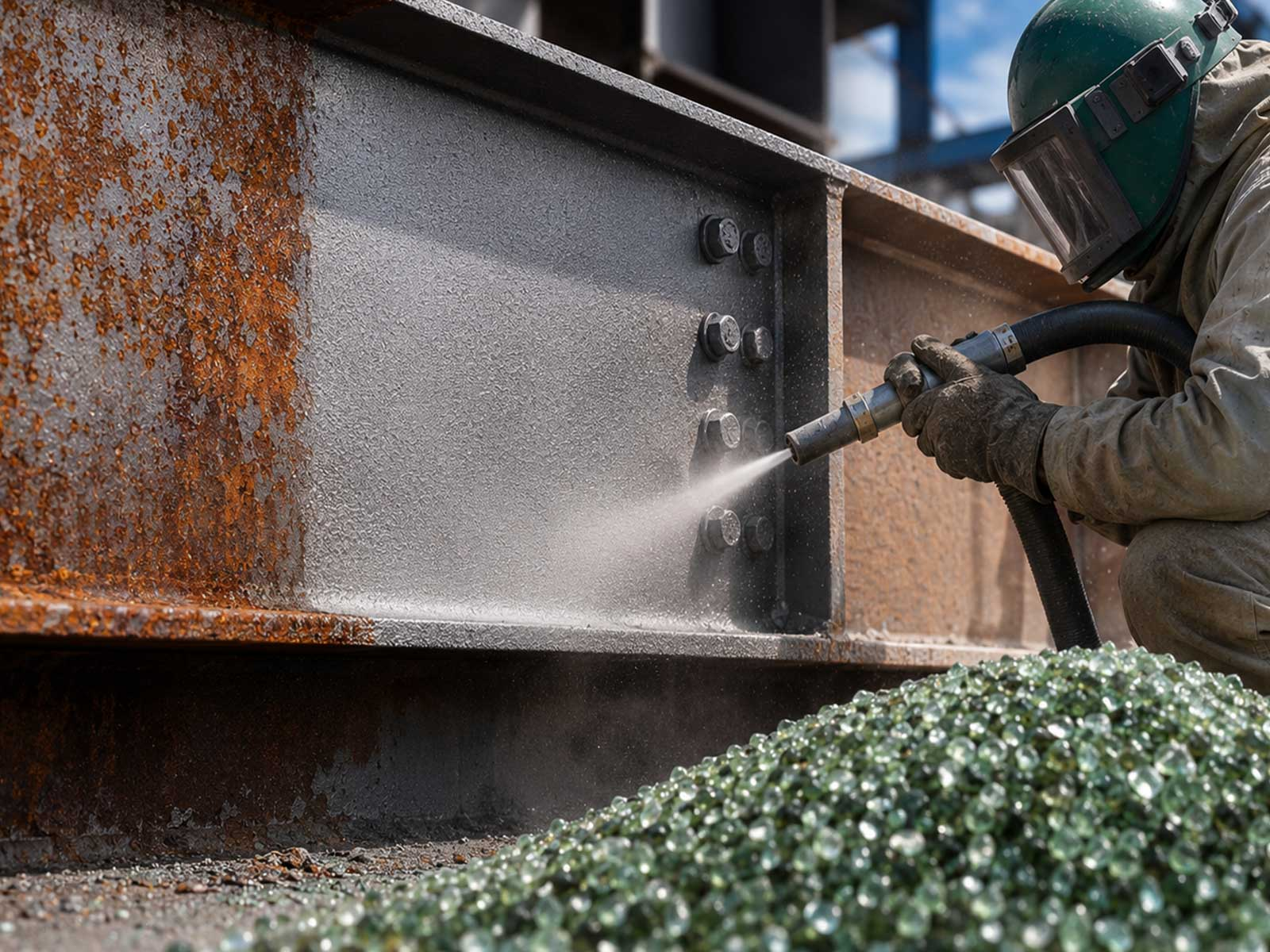
Nozzle pressure: 90–125 PSI. Nozzle size: 5/16″ to 3/8″ orifice. Nozzle distance: 6–12 inches from surface. Nozzle angle: 45–90 degrees. Use consistent overlapping passes.
Step 4 — Blast to Specification
SSPC-SP 6 / NACE 3 (Commercial Blast) for general industrial coatings. SSPC-SP 10 / NACE 2 (Near-White Blast) for high-performance coatings. SSPC-SP 5 / NACE 1 (White Metal Blast) for immersion service. Recycled glass abrasive efficiently achieves SP 10 and SP 5 ratings.
Step 5 — Inspect the Surface Profile
Use a profile gauge (Testex tape or digital profilometer) to measure Rz/Ra. Confirm cleanliness with SSPC visual standards. Glass abrasive has very low embedment tendency compared to sand.
Step 6 — Apply Coating Promptly
Blasted steel oxidizes rapidly. Apply primer within 2–4 hours in humid conditions, or up to 8 hours in dry, controlled environments.
Zafa Glass Recommendations for Steel Prep
Primary (most applications): Medium Grade 20/40 mesh. Heavy rust/scale: Coarse Grade 10/20 mesh. Finishing coat prep: Fine Grade 40/80 mesh.